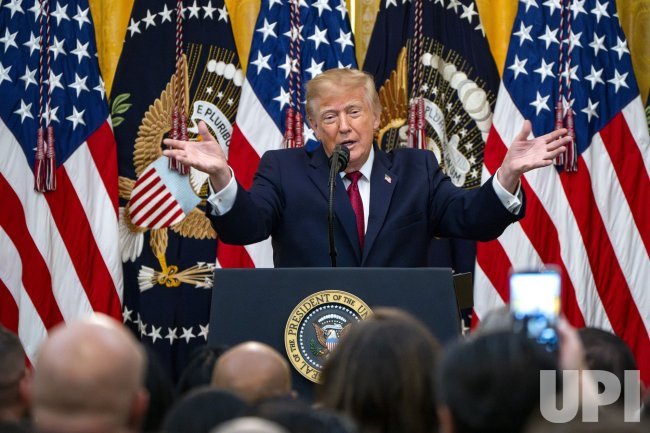
Donald Trump arrived at the White House on September 30 to celebrate Hispanic Heritage Month. It should have been a straightforward exercise in presidential outreach: a president welcoming Hispanic Americans, recognizing their contributions and speaking about the growing political importance of the country’s Latino population.
Instead, Trump spent much of the event discussing immigration, politics, his administration’s accomplishments and the unfinished ballroom being constructed at the White House. And when he took guests outside to see the construction, he made a remark that was revealing precisely because it sounded so familiar.
Warning attendees not to fall from the unfinished ballroom structure, Trump told them: “Only a Hispanic could survive that fall.” The audience cheered, and Trump added that he was therefore “not overly worried.”
It was delivered as a joke. But jokes made by presidents are not politically weightless, particularly when the joke relies on an ethnic stereotype and comes during an event specifically dedicated to celebrating the group being stereotyped.
The more important question, then, is not whether one sentence, by itself, proves anything about Trump. It is what that sentence looks like when placed against the larger record of his public rhetoric.
And that record stretches back decades.
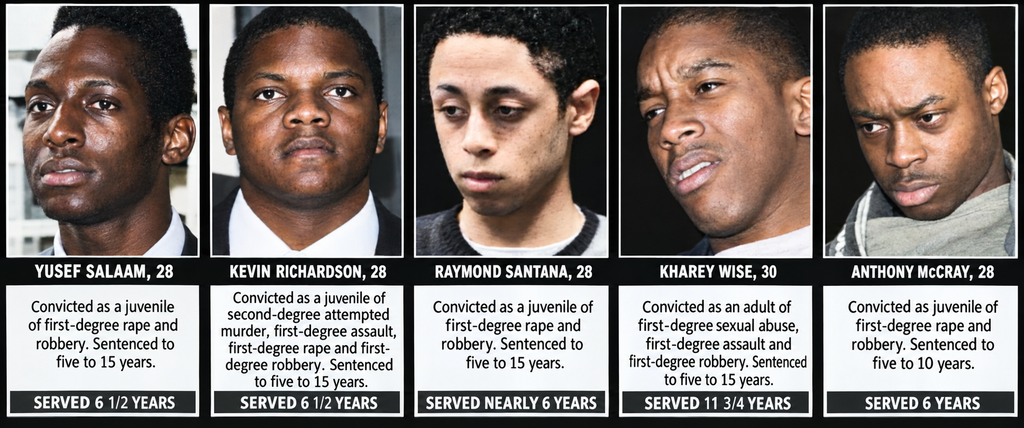
Trump’s relationship with race and ethnicity did not begin with his presidency. In 1989, he took out full-page newspaper advertisements demanding the death penalty for the five Black and Hispanic teenagers accused in the Central Park rape case. The five were later exonerated. Trump continued to maintain that they were guilty even after their exonerations. The controversy resurfaced decades later during his 2024 presidential campaign.
Then came the politics that made Trump a national political figure.
When he launched his 2015 presidential campaign, Trump spoke about Mexican immigrants in terms that immediately placed immigration, nationality, and criminality in the same political frame. His rhetoric helped establish one of the central themes of his campaign: the idea that America’s immigration system was not merely dysfunctional but dangerous.
A year later, Trump took that rhetoric into a more personal arena.
He argued that federal Judge Gonzalo Curiel could not fairly preside over litigation involving Trump University because Curiel was of Mexican heritage. Curiel was born in Indiana. Trump’s argument nevertheless treated the judge’s ancestry as relevant to his capacity to administer justice. The Congressional Record preserved Trump’s contention that Curiel’s Mexican heritage created an “inherent conflict of interest” because Trump was proposing a wall along the Mexican border.
The case, brought by the state of California and multiple groups, challenges the Department of Homeland Security’s power to waive environmental laws in constructing a border wall.
That episode matters because it went beyond undocumented immigration. It raised the question of whether ethnic identity itself could become a reason to doubt an American citizen’s loyalty or impartiality.
Trump’s rhetoric was never limited to Hispanics.
In 2015, he proposed temporarily preventing Muslims from entering the United States. In 2016, he told CNN, “I think Islam hates us,” turning a complex religion and a global population of more than a billion people into a sweeping political formulation.
Trump’s full statement on the violence in Charlottesville
In 2017, the Charlottesville controversy produced another defining episode. Trump said there were “very fine people on both sides” of the dispute over Confederate monuments. He also explicitly said he was not referring to neo-Nazis or white nationalists and that those groups should be condemned.
That distinction should not be erased. But neither should the broader controversy surrounding his comments. The episode became one of the most enduring arguments about Trump’s approach to racial politics because his language placed demonstrators on opposing sides of a conflict that had included an explicitly white-nationalist and neo-Nazi rally.
Then, in 2018, came the “shithole countries” controversy.
Almost eight years later, Trump confirms he used the phrase ‘shithole countries’
According to two people familiar with a White House immigration meeting, Trump questioned why the United States would accept immigrants from Haiti and African countries and referred to some as “shithole countries.” Trump denied using the reported language.
Again, the important issue is not simply the existence of a controversial quotation. It is the recurring pattern: immigration discussions repeatedly became discussions about the character, nationality or perceived value of entire populations.
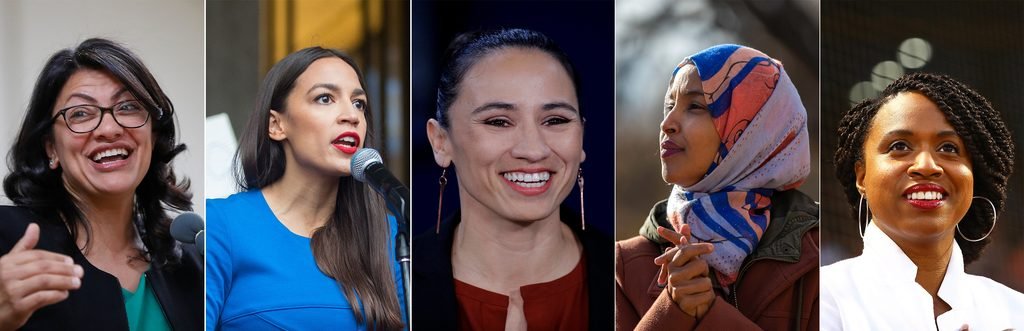
In 2019, Trump told four Democratic congresswomen—Alexandria Ocasio-Cortez, Ilhan Omar, Ayanna Pressley and Rashida Tlaib—to “go back” to the countries they came from. Three of the four were born in the United States.
Reps Ilhan Omar, Alexandria Ocasio-Cortez, Ayanna Pressley, and Rashida Tlaib hold a press conference in response to the president’s remarks
During the COVID-19 pandemic, he repeatedly used terms such as “Chinese virus” and “kung flu.” Those expressions produced criticism that the president was linking a disease to a national or ethnic identity at a moment when Asian Americans were already facing hostility.
None of these episodes should be flattened into one undifferentiated category. Immigration policy is not automatically racist. Criticism of a foreign government is not automatically racism. Describing a violent gang as “animals” is not the same as describing all immigrants that way.
And Trump’s Charlottesville remarks cannot accurately be summarized by saying he called neo-Nazis “very fine people.”
Those distinctions matter.
But the existence of distinctions does not erase the larger historical record.
What makes September 30 particularly striking is that Trump was not speaking at a campaign rally about border security. He was speaking at the White House during a celebration of Hispanic heritage.
The event itself was also politically significant.
Trump’s relationship with Hispanic voters has become more complicated, not less. According to Pew Research Center’s validated-voter analysis, Trump received 48% of Hispanic voters in 2024, compared with 36% in 2020 and 28% in 2016. Hispanic voters were therefore an important part of the broader diversification of Trump’s electoral coalition.
That fact complicates any easy story about Trump and Latino America.
Hispanic voters did not simply reject Trump because of his rhetoric. Millions voted for him.
At the same time, his administration has faced growing difficulties maintaining support among Latino voters. A Pew survey conducted in April 2026 found a substantial decline in approval among Latino voters who themselves had supported Trump in 2024.
That helps explain the importance of the September event.
Trump was attempting to cultivate a constituency that had become increasingly important to his political coalition while simultaneously defending an immigration agenda that remained central to his political identity.
Indeed, Trump himself acknowledged during the event that immigration presented a difficult political balancing act. The Washington Post reported that he said it was the most difficult issue he had handled and described himself as caught between those demanding tougher enforcement and those concerned that his approach was becoming politically damaging.
Then there was the ballroom.
The ballroom was not merely a construction project sitting in the background of the event. Trump made it part of the spectacle.
The project itself has generated controversy over cost and financing. The Washington Post reported in June that an internal contractor estimate put the project at approximately $600 million and that more than half could potentially come from taxpayers, despite Trump’s earlier claim that the project would be paid for privately.
So the symbolism of September 30 was unusually dense.
A president was celebrating Hispanic Americans.
He was simultaneously discussing immigration.
He was attempting to reinforce his relationship with Latino voters.
He was showcasing a massive White House construction project.
And then, standing above that construction site, he made an ethnic joke about Hispanic people’s ability to survive a fall.
Perhaps the most revealing part is that the remark did not occur in isolation from Trump’s political style. It fit a communication method that has characterized his public career: mixing flattery, exaggeration, humor, grievance, nationalism and group identity in ways that keep supporters engaged and opponents arguing over the precise meaning of each sentence.
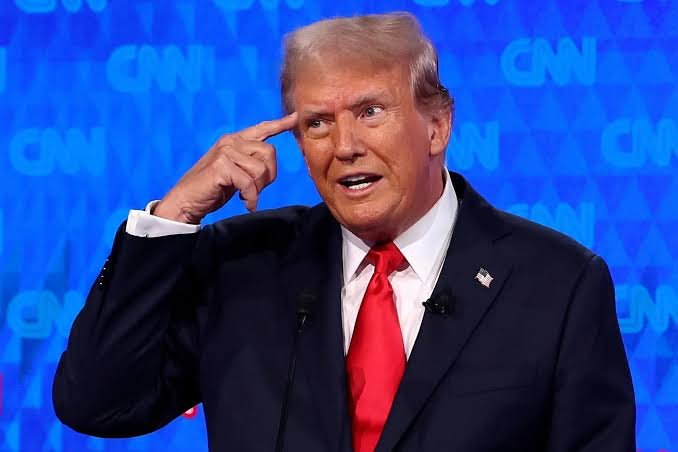
That is why the question surrounding the September 30 remark should not be reduced to whether Trump “meant” it as a racist statement.
Intent matters, but political rhetoric also has effects independent of intent.
A president can intend a joke as a compliment while still relying on a stereotype. A politician can insist that an immigration policy concerns legal status rather than ethnicity while using language that causes critics to hear something broader. And a candidate can increase his support among a minority electorate while continuing to employ rhetoric that many members of that same population find offensive.
Those contradictions are not anomalies in American politics. They are part of the story.
Trump’s 2024 gains among Hispanic voters demonstrate that Latino America cannot be understood through the assumptions of either party. Hispanic voters are not a single political bloc, and their decisions are shaped by economic concerns, immigration, religion, geography, culture, and views of government.
That makes the September 30 event more important—not less.
If Trump wants to build a durable relationship with Hispanic Americans, the question is not whether he can host a Hispanic Heritage Month celebration at the White House.
He plainly can.
The question is whether symbolic inclusion can coexist indefinitely with rhetoric that repeatedly turns ethnicity, nationality and immigration into political shorthand.
Trump’s supporters may see his language as humor, bluntness, or political authenticity. His critics may see a recurring pattern of stereotyping and demeaning rhetoric. Scholars and historians have documented the importance of immigration and identity in Trump’s political communication, while Trump’s own record provides ample material for both interpretations.
The evidence therefore does not require pretending that every controversial Trump remark is identical.
It requires taking the pattern seriously.
On September 30, the president had an opportunity to speak about Hispanic Americans as a diverse and increasingly influential part of the United States.
Instead, while celebrating them, he reached for a joke about what makes Hispanics physically different.
That may have been intended as a compliment.
But after decades of political rhetoric in which race, ethnicity, nationality, and immigration have repeatedly occupied the center of Trump’s political language, the joke inevitably carried a larger history with it.
And that is precisely why it is worth examining.