The Trump administration’s latest rescission package is being presented as a fight over wasteful spending. But the more consequential dispute is over whether a president can wait until the final days of a fiscal year to make congressionally approved money effectively disappear.
Washington’s latest budget fight is worth watching for reasons that go beyond $810 million.
On September 25, the Trump administration submitted a package of 11 proposed rescissions totaling approximately $810 million, targeting programs across the Departments of Commerce, Education, Health and Human Services, Homeland Security, Housing and Urban Development, Justice and international assistance. The timing was crucial: fiscal year 2026 ends September 30.
The administration says the targeted spending is unnecessary, wasteful, or inconsistent with its priorities. Congressional appropriators from both parties, meanwhile, have challenged the maneuver’s legality and argued that it interferes with Congress’s constitutional authority over federal spending.
That disagreement turns a collection of program cuts into a much larger institutional question.
Congress writes appropriations laws. The executive branch administers them. What happens when an administration decides that money Congress has already appropriated should not be spent—and waits until the end of the fiscal year to decide?
That question is at the center of the latest “pocket rescission” fight.
What is the White House actually proposing?
The White House’s September 25 letter to Speaker Mike Johnson invoked Section 1012 of the Congressional Budget and Impoundment Control Act of 1974 and formally transmitted 11 rescission proposals totaling $810 million.
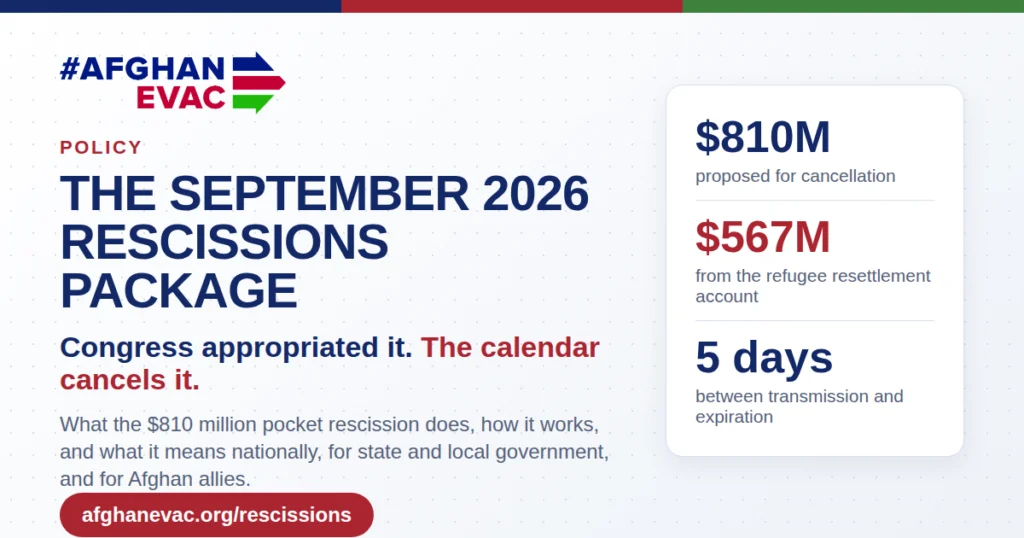
The largest proposal is $567.4 million from the Health and Human Services account for Refugee and Entrant Assistance. The administration says the account is overfunded because arrivals have declined under its border and refugee policies. The targeted account supports programs administered through the Office of Refugee Resettlement and serves refugees, asylees, and other eligible noncitizens.
Education is another major target.
The package proposes roughly $24.9 million from the $52 million Congress appropriated for competitive grants under Special Programs for Migrant Students. It also proposes nearly $69.6 million from the $70.3 million appropriated for International Education and Foreign Language domestic programs.
Other proposals include:
- $27.7 million from the Agency for Healthcare Research and Quality;
- $56.1 million from HUD’s Housing Counseling Assistance account;
- $15 million from FEMA’s Alternatives to Detention-Case Management Pilot Program;
- $10 million from the Citizenship and Integration grant program;
- $10 million from the Minority Business Development Agency;
- $15 million from the Justice Department’s Community Relations Service;
- approximately $8.7 million from the Treasury Department’s Tropical Forest and Coral Reef Conservation Act program; and
- about $5.1 million associated with the HHS Office of Minority Health.
The administration’s descriptions are themselves politically consequential. They characterize some programs as supporting illegal immigration, “woke” projects, racial preferences, or unnecessary spending. Those are the administration’s justifications—not independent findings that each program is wasteful or unlawful.
That distinction matters.
The education fight is more complicated than the White House description
Consider HEP and CAMP, the High School Equivalency Program and College Assistance Migrant Program.
You can check it out at: http a://www.hepcampassociation.org/press-release
The Education Department describes HEP as a program for individuals from migrant and seasonal farmworker backgrounds seeking to obtain a secondary-school equivalency credential. The department’s FY2026 materials continue to list HEP and CAMP as active programs and solicited applications and peer reviewers for the fiscal year.
Education Week reported that Congress provided $52 million for HEP and CAMP for FY2026 after the administration had previously proposed eliminating funding. It also reported that earlier grant competitions projected roughly $25 million in awards across nine institutions.
The history is significant.
During 2025, the Education Department canceled planned competitions for new HEP and CAMP awards and discontinued more than 40 existing grants, according to Education Week. The HEP-CAMP Association subsequently sued, and an agreement with the administration required the department to spend the $52 million Congress had appropriated, although the number of participating programs was reduced.
Education Week reported that HEP and CAMP served about 5,000 students through roughly 120 programs in 20 states as of 2024, but the number of programs fell to about 45 in 12 states under the Trump administration. The association estimated that the money now targeted by the rescission could have supported services for roughly 1,650 students.
There is another important factual issue.
The White House says the migrant-student program “subsidizes aliens to come to the United States.” But Education Week reported that the programs serve students who qualify through the federal migrant education framework and that undocumented immigrants are prohibited from participating. The White House also cited an alleged HEP-CAMP grant to Immigrants Rising. At the same time, the federal spending database did not show a HEP or CAMP award to that organization, according to Education Week.
That does not settle the broader policy debate. It does, however, demonstrate why the administration’s descriptions need to be checked against the actual statutory eligibility rules and grant records.
The timing is the real story.
The legal mechanics are easier to understand with one distinction.
An appropriation is Congress’s legal authorization of federal spending for a specified purpose. An obligation is the government’s legally binding commitment to spend that money. An expenditure occurs when the government actually pays the money.
Those stages are not interchangeable.
The federal government can therefore possess appropriated money that has not yet been obligated. But the executive branch does not automatically acquire the power to erase an appropriation simply because an agency has not yet obligated every dollar.
The Impoundment Control Act established a process for presidential rescission proposals.
Under 2 U.S.C. § 6, when the President proposes rescinding budget authority, the relevant funds generally must remain available unless Congress completes action on a rescission bill within the statutory 45-day period.
That creates the unusual mechanism known as a “pocket rescission.”
The President sends Congress a rescission proposal close enough to the end of a fiscal period that the funds can expire before Congress has had a full opportunity to consider it.
The Government Accountability Office has repeatedly said this is not permitted.
GAO’s current Impoundment Control Act guidance states directly that the law does not permit the withholding of funds proposed for rescission through their expiration date. If Congress does not affirmatively rescind the money, GAO says the funds must be made available for prudent obligation before they expire.
GAO has reached the same conclusion in formal decisions. In 2025, for example, it stated that the Impoundment Control Act does not authorize withholding budget authority until its expiration and that “pocket rescissions” are inconsistent with the Act.
That makes the September 30 deadline more than a calendar detail.
It is the mechanism around which the dispute is built.
Congress says it was denied the opportunity to act.
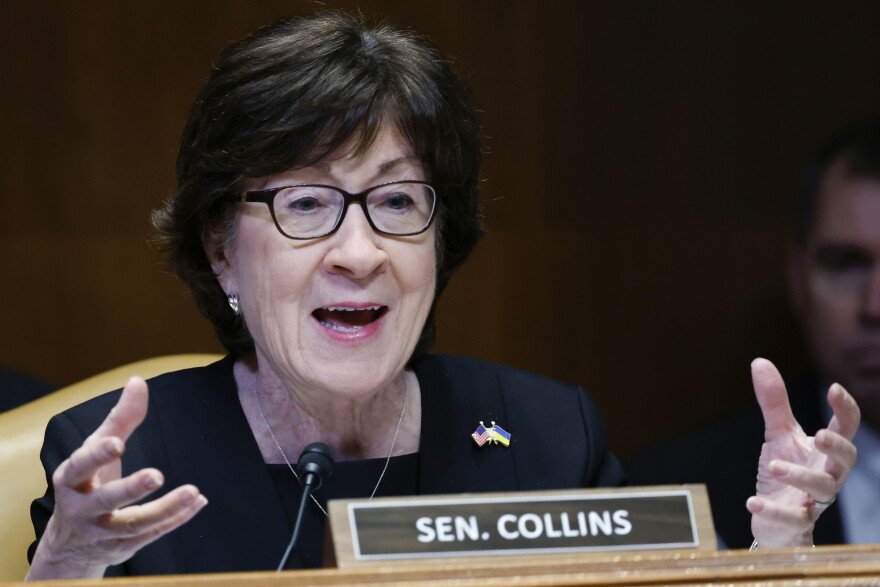
Senate Appropriations Chair Susan Collins, a Republican, described the September 25 package as an unlawful attempt to undermine Congress’s power of the purse. She said OMB had withheld funds for months before presenting the rescission package and argued that the executive branch cannot simply decide which congressionally funded programs are worth supporting.
House Appropriations ranking Democrat Rosa DeLauro made a similar argument, saying the administration had been unlawfully impounding funds during the year and that the last-minute proposal compounded the problem.
The unusual element is not simply that Democrats objected.
A Republican Senate appropriator who chairs the committee responsible for federal spending also objected.
That bipartisan disagreement does not establish that the administration’s position is legally wrong. It does establish that the dispute cannot accurately be described as merely a routine partisan disagreement over whether particular programs are desirable.
It is a dispute over the procedure by which the executive branch can decline to spend money Congress has appropriated.
But GAO is not a court
This distinction is crucial.
GAO is an independent congressional watchdog with a statutory role in reviewing impoundments and supporting Congress’s exercise of its appropriations authority. Its legal decisions carry significant weight in federal appropriations practice, but GAO is not the Supreme Court.
The administration and its allies can therefore contest GAO’s interpretation in Court.
And the Supreme Court’s treatment of the administration’s 2025 foreign-aid rescission effort makes the situation considerably more complicated.
The 2025 precedent does not mean the Supreme Court declared pocket rescissions legal.
In 2025, the Trump administration proposed rescinding roughly $4 billion in foreign-assistance funding shortly before approximately $10.5 billion in appropriated aid was scheduled to expire.
The dispute reached the Supreme Court in an emergency application.
On September 26, 2025, the Court stayed a lower-court injunction as it applied to funds coPresident’s rescission proposal. But the Court expressly stated that its order was not a final determination on the merits. It said the administration had made a sufficient showing at the preliminary stage that the Impoundment Control Act precluded the particular lawsuit brought under the Administrative Procedure Act.
That is materially different from saying that the Supreme Court held that presidents possess an unlimited authority to use pocket rescissions.
Indeed, the Court’s order expressly described the relief as interim and tied it to the litigation and the specific foreign-assistance funds at issue.
The distinction matters in 2026 because the current package concerns domestic programs across education, health, housing, immigration, and other areas.
The 2025 case therefore supplies an important precedent for the administration’s position, but it does not erase the underlying legal disagreement.
GAO’s record makes the dispute broader than one rescission package
The current fight also arrives after a series of GAO decisions examining Trump administration actions involving appropriated funds.
In 2025, GAO concluded that HHS violated the Impoundment Control Act by withholding Head Start funds. It also found that HHS violated the Act when NIH withheld funds from obligation and expenditure amid actions affecting the grant-making process.
In another 2025 decision concerning FEMA funds, GAO again emphasized that executive officials must prudently obligate appropriations during their period of availability unless Congress has enacted a law permitting otherwise.
Those decisions do not automatically determine the legality of the September 2026 package.
But they provide important context.
The administration is not operating in a legal vacuum. Its approach to congressional appropriations has already produced repeated disputes over whether executive delays are ordinary programmatic decisions or unlawful impoundments.
The administration has a substantive argument, too
It would be incomplete to treat this entirely as a procedural story.
The White House has a substantive argument: Congress appropriated money for programs whose needs, in the administration’s view, have changed. The administration says fewer arrivals at the southern border mean the Refugee and Entrant Assistance account has more money than necessary. It says certain education and research programs have moved beyond their intended missions. It argues that other programs conflict with executive policies concerning immigration, diversity, and federal spending.
Presidents routinely propose eliminating programs they believe are ineffective or inconsistent with their priorities.
That political process is nothing unusual.
The unusual question is what happens when the executive branch attempts to achieve that objective through the timing of appropriations rather than through a new law passed by Congress.
That is where policy preference and institutional authority collide.
The constitutional question is bigger than Trump.
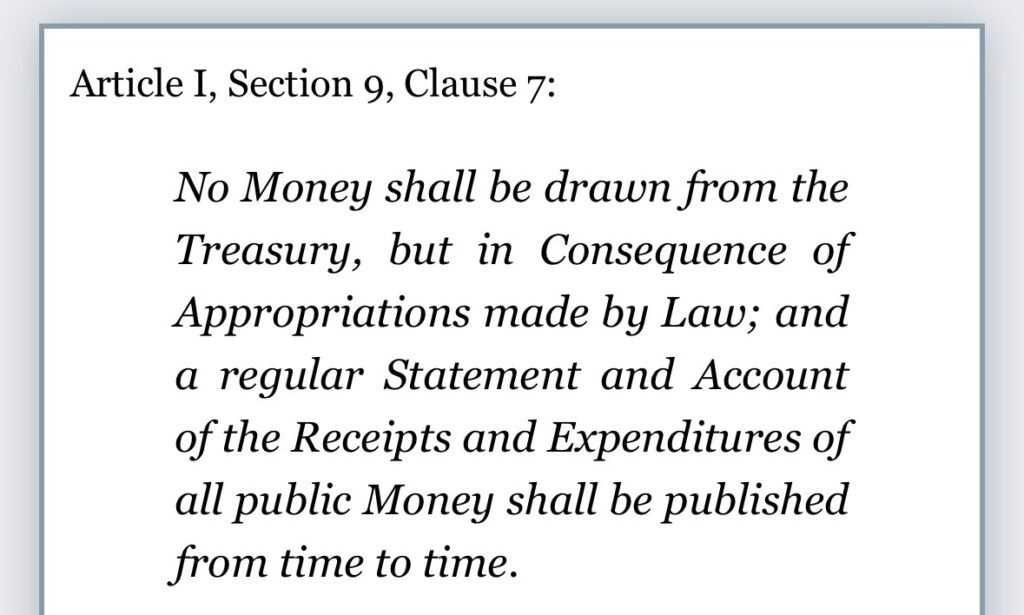
Article I, Section 9 of the Constitution gives Congress the power to appropriate federal money. Meanwhile, the executive branch carries out federal law.
The Impoundment Control Act was enacted after years of disputes over presidential withholding of appropriated funds. GAO has described the statute as establishing limited circumstances under which the President can withhold budget authority while protecting Congress’s appropriations role.
The institutional concern is therefore not confined to one administration.
If a Republican president can use the end of a fiscal year to prevent Congress’s appropriations from being spent, a future Democratic president could theoretically seek to use the same mechanism for programs favored by Congress but opposed by the White House.
And if the practice becomes normalized, congressional appropriations could lose practical importance even without a formal constitutional amendment.
Congress could still pass spending bills.
But the executive branch would have a powerful additional tool: delay.
That possibility is why the timing of the $810 million package matters so much.
A deadline can become a governing tool.
The ordinary rescission process assumes that Congress has an opportunity to review the President’s proposal.
A last-minute rescission changes the practical equation.
The White House can present Congress with a choice after much of the fiscal year has passed, while the House may be out of session and the fiscal deadline approaches. Roll Call reported that the House was not scheduled to return until after the November midterm elections, leaving lawmakers little time to respond before September 30.
That does not automatically establish illegality.
It does, however, explain why the procedure has generated such a strong institutional reaction.
The central question becomes whether the statutory 45-day review period is meant to give Congress a genuine opportunity to approve or reject a rescission—or whether the executive branch can structure the timing so that the money expires before Congress can realistically act.
GAO’s answer has been clear: the latter approach is not permitted under the Impoundment Control Act.
The administration’s position and the eventual judicial response will determine how far that interpretation ultimately extends.
The real test is what happens next.
The $810 million itself is relatively small compared with the federal government’s overall budget.
That is precisely why the institutional question deserves attention.
A dispute involving hundreds of millions of dollars can establish a procedure that could later be used with billions.
Congressional appropriators are already considering responses. Collins has indicated that lawmakers may seek language addressing pocket rescissions in future spending legislation.
Meanwhile, the administration has shown it intends to keep using aggressive executive tools to pursue spending priorities even when Congress has appropriated money for programs it wants to shrink or eliminate.
The courts may ultimately have to clarify where the statutory boundary lies.
Until then, two propositions can coexist.
The President has a legitimate political interest in eliminating programs he considers wasteful.
Congress has a constitutional role in deciding what federal programs receive appropriated funds.
The unresolved question is what happens when those two authorities collide at the very end of the fiscal year.
The money is only half the story.
The easiest way to describe the September 2026 episode is as another fight over federal spending.
The harder—and more consequential—way is to see it as a test of how the federal budget actually works.
Congress appropriates.
The executive administers.
The Impoundment Control Act gives the President a mechanism to ask Congress to rescind appropriations.
But if the executive branch can withhold funds long enough for them to expire before Congress has a meaningful chance to act, the distinction between proposing a rescission and accomplishing one becomes much less clear.
That is why the $810 million package matters beyond the individual programs on its list.
The immediate dispute is over refugees, migrant education, foreign-language programs, research, housing counseling, and other federal activities.
The institutional dispute is over something more basic:
When Congress passes a spending bill, the President signs it; who gets the final word on whether that money can actually be spent?
The answer is not merely a question of which programs Americans support.
It is a question of how the constitutional machinery of the federal government is supposed to work—and whether the power of the purse remains with the institution the Constitution assigned it to.